
A manuscript editor that
catches errors early
We make it possible to apply large language models safely and transparently in scientific publishing. Our AI understands your manuscript in full context — including cited references and domain language — to provide precise, verifiable assistance that makes research writing faster, clearer, and more accountable.
Trusted by researchers at




Write your manuscript with AI assistance
More than a manuscript editor—your complete research workspace
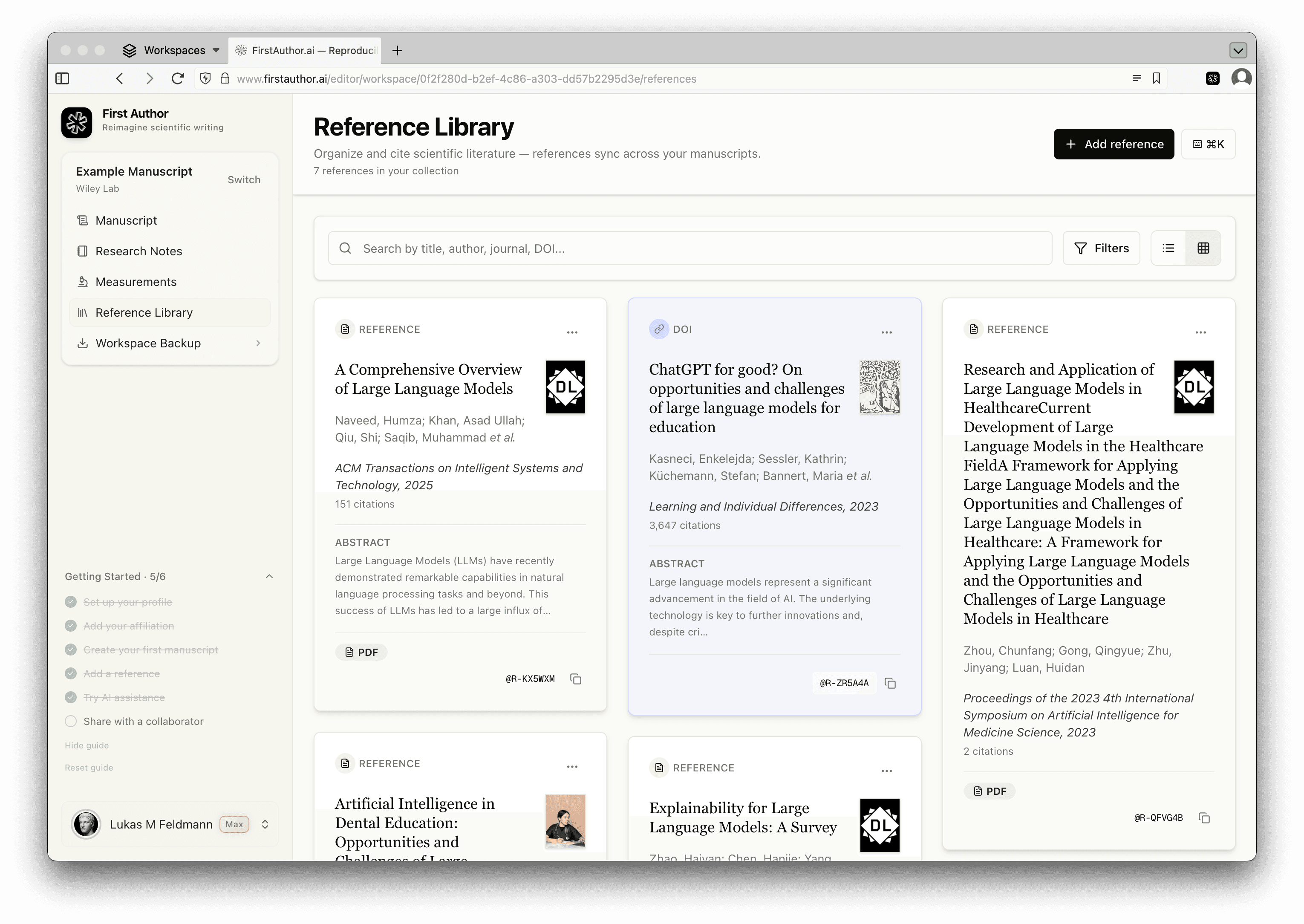
Manuscript, notes, measurements, and references—all in one place. Track your experimental data alongside your writing. Control who can make direct edits and who must use track changes. Link measurements from your research notes directly into manuscript text. Manage collaboration permissions at the workspace level. Everything syncs automatically.
A reference manager that actually works
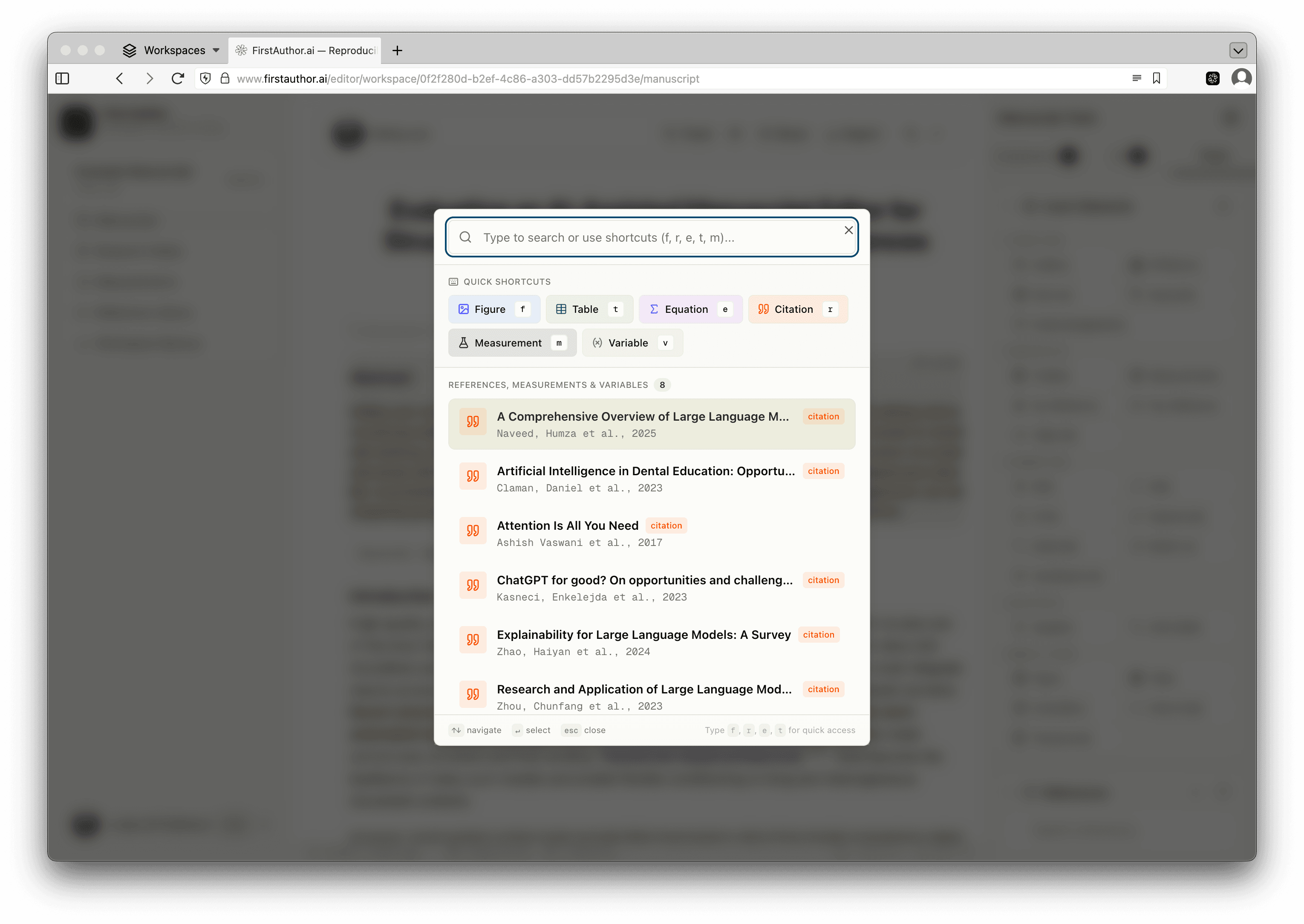
Find papers directly inside First Author with our search engine that prioritizes relevant results—then cite them instantly. No context switching. No broken links.
Survival trade-offs in plant roots during colonization by closely related beneficial and pathogenic fungi
The sessile nature of plants forced them to evolve mechanisms to prioritize their responses to simultaneous stresses, including colonization by microbes or nutrient starvation. Here, we compare the genomes o...
See exactly who changed what, when
Every edit is attributed. Comments thread directly on the text. Suggest changes that authors can accept or reject. Perfect for reviewer feedback, co-author revisions, and PI comments.
Our findings indicate demonstrate that the novel pathway plays a critical role in cellular response.
"Demonstrate" is stronger here. Can we add a reference to support this claim?
Full control over collaboration
Share links with external collaborators. Decide who can edit directly and who must use track changes.
Enforce track changes
All edits from this link will be tracked
Values that update themselves
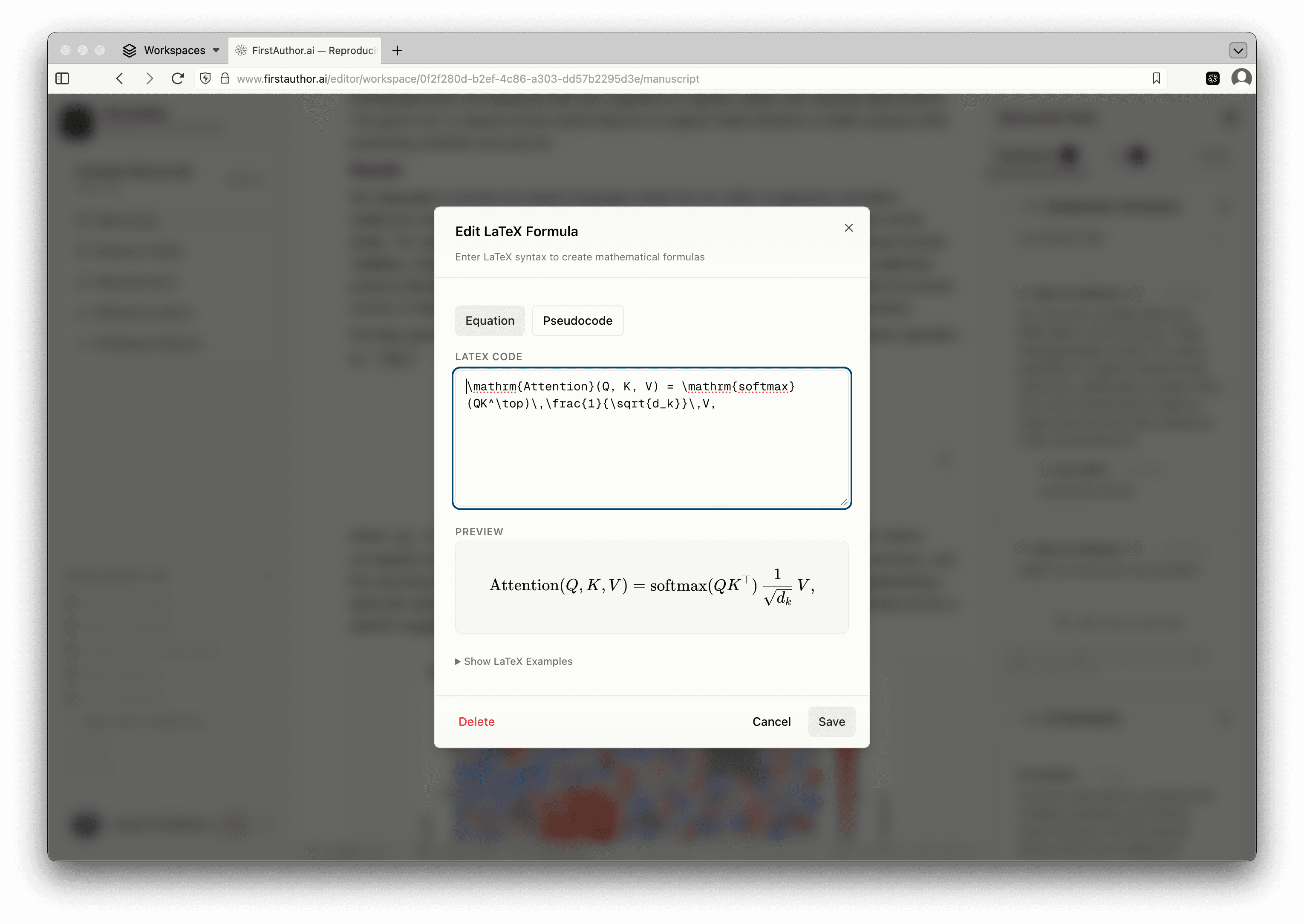
Store experimental measurements in your research notes. Reference them in your manuscript. When the analysis changes, every citation updates automatically—no copy-paste errors.
The ptsHOPERONptsH SourceResearch notesanalysis.ipynbLast changed:2 hours agoType:ValueID:m-opero operon spans 12,847 bpLENGTH12,847 bpSourceResearch notesanalysis.ipynbLast changed:Just nowType:ValueID:m-lengt and encodes 7 genesGENE COUNT7 genesSourceResearch notesanalysis.ipynbLast changed:Just nowType:ValueID:m-gene genes. The region has a G+C content of 52.3 %G+C CONTENT52.3 %SourceResearch notesanalysis.ipynbLast changed:Just nowType:FloatID:m-g+c c and an average gene length of 1,347 bpAVG LENGTH1,347 bpSourceResearch notesanalysis.ipynbLast changed:2 hours agoType:ValueID:m-avg l.
Two AI assistants designed to catch manuscript errors
Pro and Max plans include Helion and Aureon—specialized AI assistants that review your manuscript at two levels. Helion catches surface issues like typos, grammar, and spelling in real-time. Aureon goes deeper, analyzing structure, logical consistency, and the accuracy of scientific claims. Together, they help ensure your work is polished before submission.
Save references while you browse
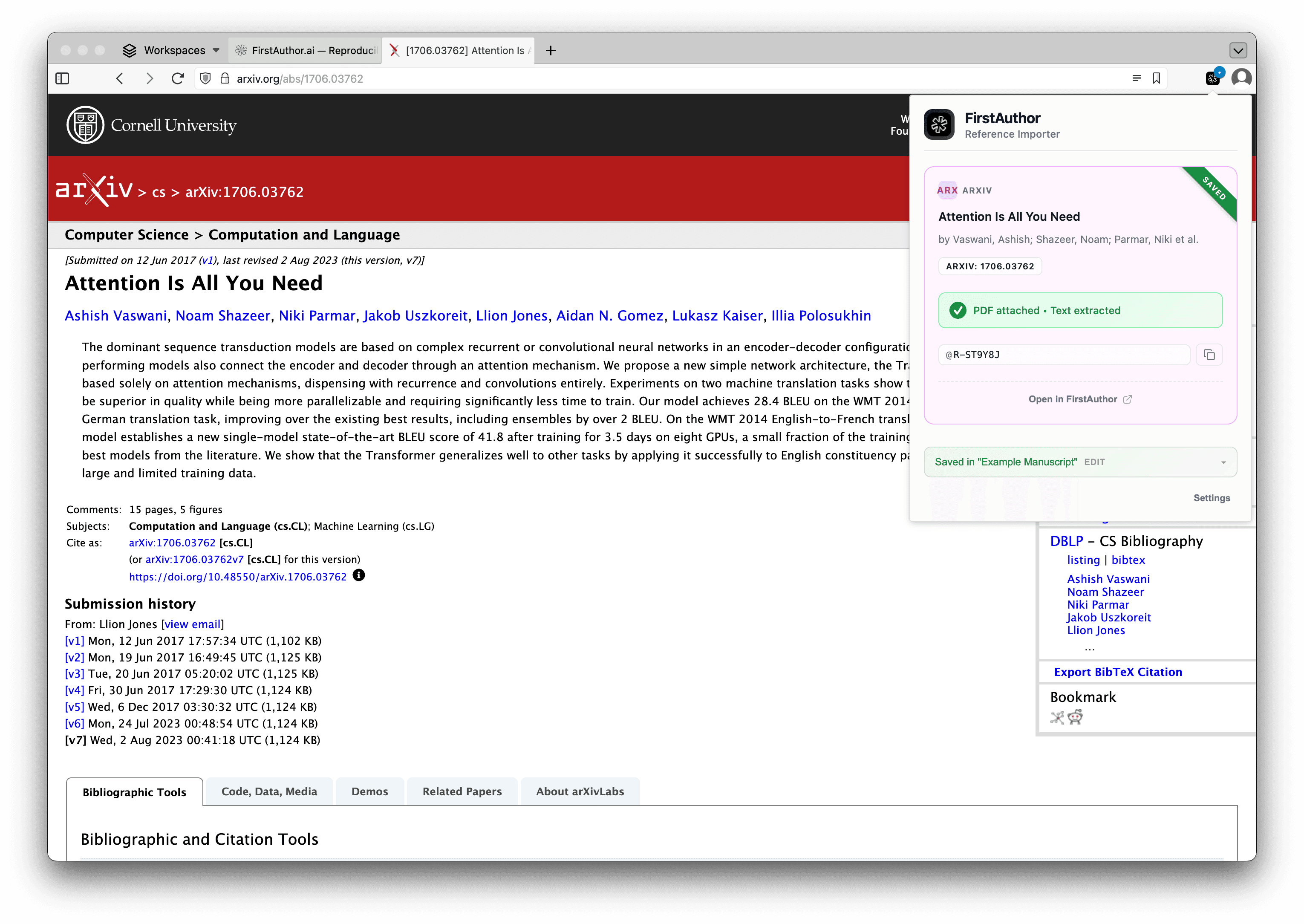
Our Chrome extension automatically detects papers on PubMed, Google Scholar, arXiv, bioRxiv, and publisher sites. One click saves the reference—with PDF and full metadata—directly to your workspace.
- Automatically extracts title, authors, journal, and DOI
- Downloads and attaches PDFs when available
- Generates citation keys for instant manuscript insertion
- Works with PubMed, Google Scholar, arXiv, bioRxiv, and more

Choose your plan
All plans include unlimited workspaces, real-time collaboration, and reference management.
Free
Get started with semantic writing
- Real-time collaboration
- Reference manager
- Track Changes
- Equation checking
- Automated reference checks
- Helion AI manuscript assistant
- Aureon AI manuscript assistant
Pro
Precise, reference-aware scientific editing
Precise scientific editing
- Everything in Free
- AI usage transparency report
- Helion AI manuscript assistant
- Track Changes
- Chat with references
- Equation checking
- Automated reference checks (25/month)
Max
Advanced AI for deep manuscript analysis
Deep manuscript analysis & feedback
- Everything in Pro
- Aureon AI manuscript assistant
- Automated reference checks (100/month)
- 5× Helion usage
- Early access to new features
Institutional
For universities, research institutes, and academic organizations. Private deployment, support for self-hosting or private LLM providers, and dedicated support.
Reserve a seat for free
We're opening access gradually. Request early access to be notified when the next cohort opens.